What Colours Work in a Gustavian Bedroom?
What Colours Work in a Gustavian Bedroom?
Blanched almond, natural linen, apricot, and muted army green are the four colours that define an authentic Gustavian bedroom palette -warm, faded, and quietly sophisticated. Together they create a room that feels like it has always been there.
The Gustavian style -rooted in 18th-century Swedish neoclassicism -was always about restraint with warmth. Pale carved woodwork, upholstered pieces in muted textiles, natural floors, and just enough colour to keep it from feeling cold. The palette in this room proves the formula still works.
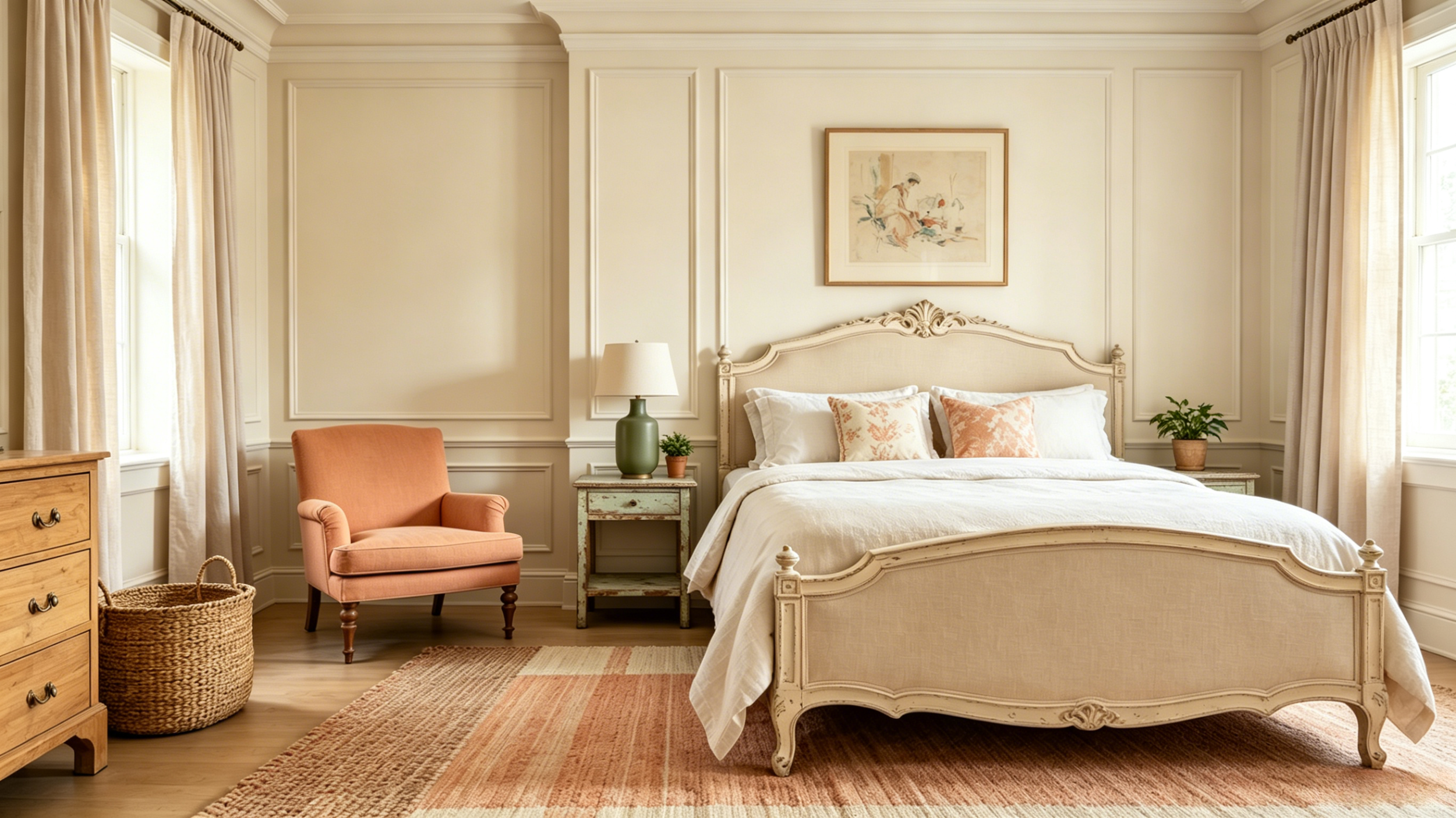
The bed frame that tells a hundred years of stories
Gustavian quiet luxury.
What Is the Gustavian Colour Palette and Where Does It Come From?
Gustav III of Sweden returned from Versailles in the 1770s and brought French neoclassical style home -but filtered through a Nordic lens. Less gilded, more painted. Less grandeur, more liveable grace. The resulting interiors favoured chalky whites, warm greys, and soft earth tones over the saturated jewel colours of French baroque.
Today's interpretation adds warmth: blanched almond on panelled walls instead of cool grey-white; apricot in upholstery instead of dusty rose; army green as an earthy accent that reads as aged rather than decorative.
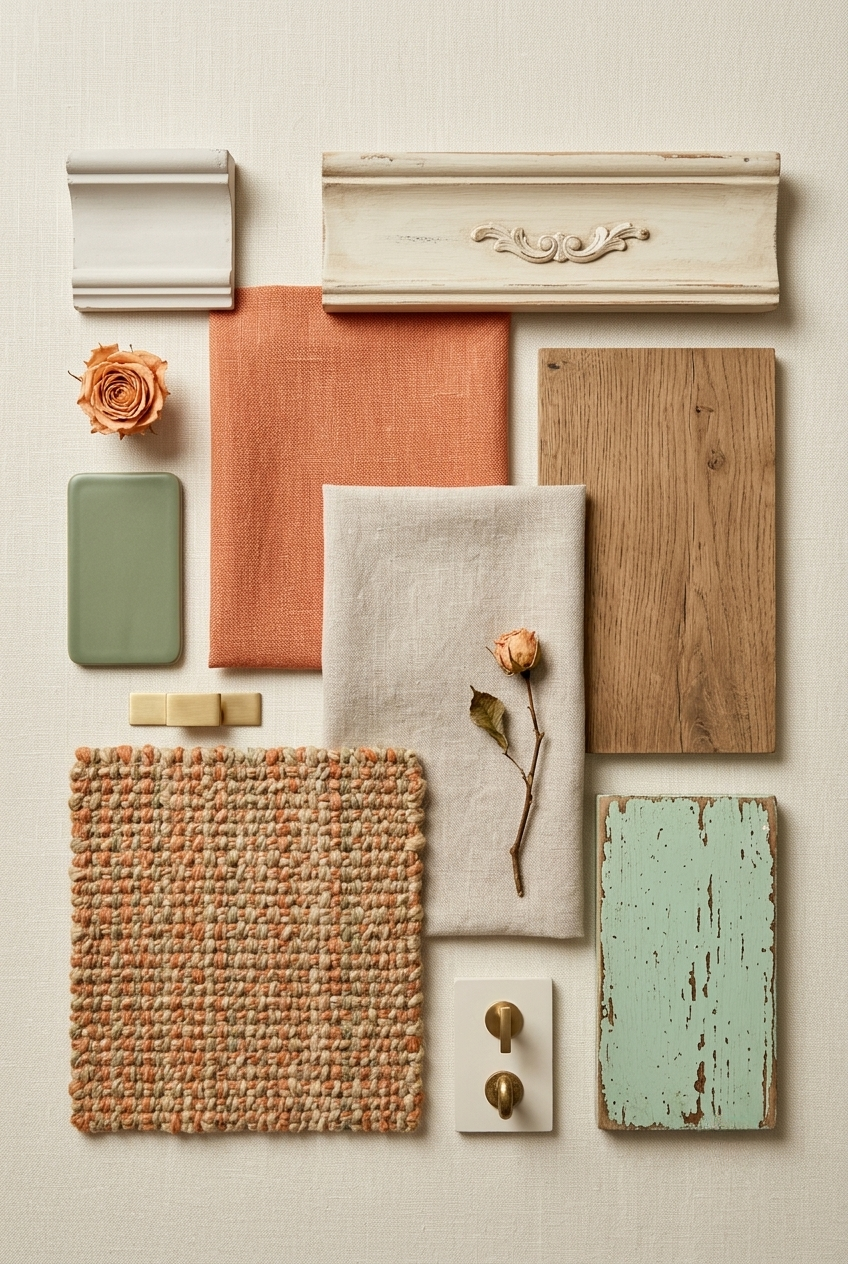
How Do You Build a Gustavian Colour Palette from Scratch?
Start with the mood board before you touch a paint swatch.
The palette shown here works because every element relates back to the same tonal family -warm and faded, with just enough contrast to feel considered:
Blanched almond -walls, carved bed frame, panelling. The base that everything else sits against.
Apricot / terracotta linen -upholstered armchair, cushions, accent fabric. The warmth provider.
Natural linen -bedding, curtains, bench upholstery.
Army green -ceramic lamp base, distressed nightstand, tile accent. The grounding note.
Reclaimed oak -flooring, chest of drawers. The material anchor.
Brass -hardware, tap fittings. The metallic detail that keeps everything from reading as purely rustic. Small quantities, warm finish.
What Furniture Defines a Gustavian Bedroom?
Pieces carry the style:
The bed frame. Carved, painted, and upholstered -the Gustavian bed is the room's centrepiece. The typical form has a curved headboard with scrolled or floral carved detail in a chalky white or distressed cream finish. The upholstered panel in the headboard is almost always in natural linen or a faded floral.
The nightstand. Distressed paint -the kind that looks like it came from a Swedish country house, not a furniture store -in a faded sage or verdigris green. One small drawer. A marble or aged timber top. The imperfection is the point.
The accent chair. A wingback or club chair in apricot or terracotta linen on dark turned legs. Low-profile, positioned in the corner near natural light. This is the colour-forward piece in the room -the one that makes the palette feel considered rather than accidental.
Supporting pieces -an oak chest of drawers with black iron hardware, a tufted bench in natural linen at the foot of the bed, a jute rug in terracotta and natural tones -complete the room without competing with the three hero pieces.
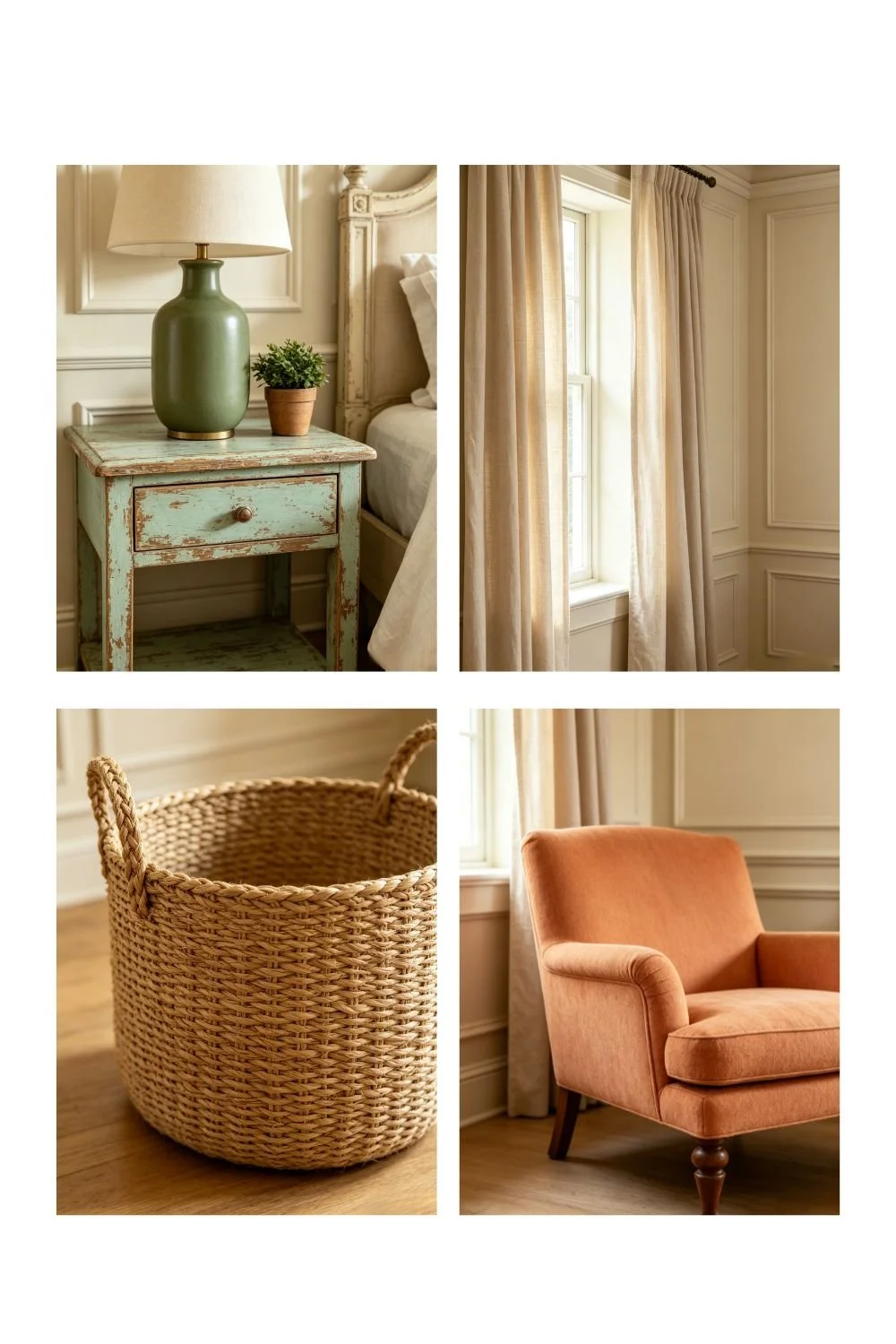
What Textiles and Materials Make a Gustavian Room Feel Authentic?
The mood board answers this precisely:
Natural linen and heavy-weave linen in warm neutral and apricot tones. Jute in a chunky flatweave, mixed with terracotta fibres. Reclaimed or wire-brushed oak timber. Distressed painted wood in faded sage. Sage green ceramic. Carved plaster moulding in chalky white. Brass hardware in a satin or antique finish.
The materials list is short by design. Gustavian interiors work because they repeat a small number of honest materials with confidence rather than layering many different ones. Linen, oak, painted wood, jute, ceramic, brass -that's the full vocabulary.
What Wall Treatment Works in a Gustavian Bedroom?
Panelling, always. The signature of Gustavian interiors is the panelled wall -simple rectangular mouldings in a painted finish, typically the same colour as the wall itself. The effect is architectural depth without pattern or colour contrast.
Paint the panels in blanched almond or a very warm off-white. The moulding profile should be simple -Gustavian panelling is more refined than Victorian; the lines are cleaner, less ornate. Crown moulding at the ceiling in the same colour completes the look.
FAQ
What is Gustavian style in interior design? Gustavian is a Swedish neoclassical style from the late 18th century, influenced by French and Italian classicism but simplified for Nordic sensibility. It is defined by painted carved furniture, muted warm palettes, natural linen textiles, and restrained architectural detail. The overall feeling is faded elegance -refined but not precious.
What paint colour is used in Gustavian interiors? Blanched almond, warm chalky white, and faded grey-greens are the most authentic choices. The key is warmth without saturation -avoid cool whites or stark bright tones, which flatten the carved detail and aged materials that define the style.
What is the difference between Gustavian and French country style? Gustavian is more restrained and less floral than French country. Where French country leans into printed fabrics, warmer golds, and heavier ornamentation, Gustavian stays paler, more architectural, and more minimal in its textile choices. The carved furniture in both styles is similar, but the Gustavian palette is cooler and more disciplined.
Can Gustavian style work in a modern home? Yes -and it works best when it's interpreted rather than replicated. In a contemporary home, keep the panelled walls and the painted carved bed frame, but pair them with modern ceramics, natural linen bedding, and a simple jute rug. The contrast between classical architecture and restrained contemporary furnishings is exactly where the style feels most alive today.
What colours accent a Gustavian palette? Apricot, terracotta, sage green, and warm brass are the most natural accent choices. These tones are found throughout 18th-century Swedish interiors -in painted furniture, delftware, and woven textiles -and they add warmth to a palette that might otherwise read as too pale.