What Size Chandelier Should You Hang Over a Dining Table?
A dining table sets the scale of a room, but it's the light fixture above it that decides whether the whole space feels finished or slightly off. Too small, and a chandelier looks lost, floating above the table without anchoring it. Too large, and it can dominate a room that was meant to feel warm and inviting rather than overwhelming. Getting this one proportion right is one of the simplest ways to make a dining room look intentional.
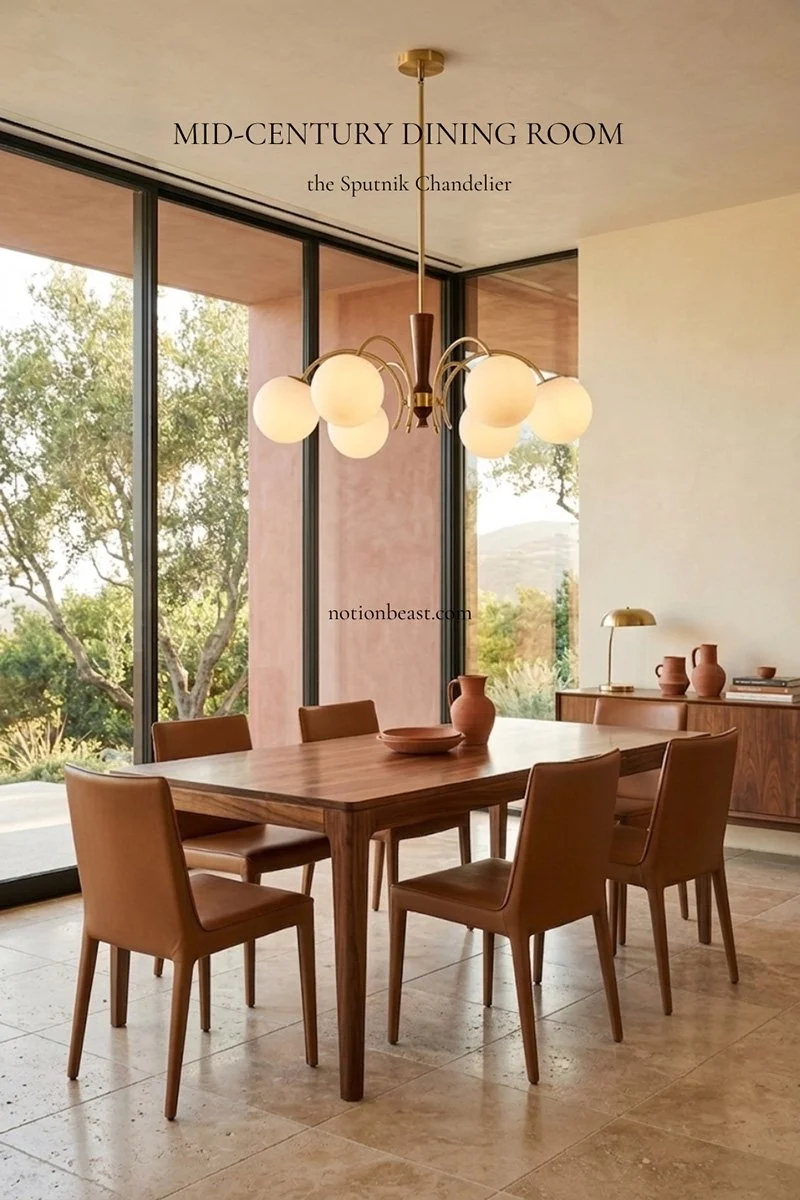
The chandelier's diameter should generally measure one-half to two-thirds the width of your dining table, centered directly above it. For example, a 60-inch-wide table suits a chandelier between 30 and 40 inches wide. This single ratio is the most reliable starting point, and it works whether your table is round, rectangular, or oval.
Below, we break this down further, including hanging height, ceiling considerations, and how to choose a shape and style that suits the table you already have.
How Do I Calculate the Right Chandelier Size for My Table?
Measure the width of your dining table, then multiply that number by 0.5 and by 0.67. The result is your ideal diameter range. A 48-inch table, for instance, suits a chandelier between 24 and 32 inches wide. This keeps the fixture substantial enough to feel like a real presence over the table, without overwhelming the place settings or making the room feel crowded.
If you don't have a table yet, the room itself can guide you instead: add the room's length and width in feet, then convert that number to inches for an approximate chandelier diameter.
What Style of Chandelier Suits a Mid-Century or Contemporary Dining Room?
Open, sculptural multi-arm fixtures, often called Sputnik chandeliers, are one of the more enduring choices for mid-century modern and contemporary dining rooms. The radiating brass or metal arms and glass globe shades bring a sense of movement and warmth without the visual weight of a traditional crystal chandelier, which makes them a natural fit for warm, earthy interiors built around walnut furniture and soft neutral tones.
The 6-Light Sputnik Chandelier is a fitting example, brass-finished arms paired with frosted glass globes, designed to sit comfortably in either a true mid-century space or a warmer contemporary dining room without overpowering the table beneath it.

6-Light Sputnik Chandelier A brass-finished, open-arm chandelier with six frosted glass globes, designed for dining tables roughly 60–84 inches wide, sized to anchor the table without crowding the room around it. Suits mid-century modern and warm contemporary dining spaces, and ships to Australia and the US.
Should I Choose a Larger or Smaller Chandelier If I'm Unsure?
When in doubt, stay closer to the lower end of your calculated range rather than the upper end. A chandelier that's slightly smaller than the maximum still anchors the table and reads as intentional, while one that's oversized for the room is harder to live with day to day and more noticeable as a misstep.
How High Should a Chandelier Hang Above a Dining Table?
For a standard 8-foot ceiling, the bottom of the chandelier should sit 30 to 36 inches above the table surface. This gives enough clearance to see across the table comfortably while keeping the fixture low enough to feel connected to the space below it, rather than floating up near the ceiling. For every foot of ceiling height above 8 feet, add roughly 3 inches to that hanging distance.
Does the Shape of My Table Affect Which Chandelier Style Works Best?
Yes. Round and square tables generally pair well with a chandelier that has a wide, radiating silhouette, such as a Sputnik-style fixture, since the shape echoes outward in a similar way the table does. Rectangular and oval tables often suit either a single statement chandelier centered over the table, or, for longer tables, a linear fixture or row of pendants spaced evenly along the length.
A multi-arm, open-frame design like a Sputnik chandelier tends to feel lighter and less heavy than a closed or drum-style fixture of the same diameter, which matters if you're working with a smaller dining room or want the light to feel sculptural rather than dense.
Frequently Asked Questions
What size chandelier should I use for a dining table? As a general rule, the chandelier's diameter should be one-half to two-thirds the width of the table. A 60-inch table suits a chandelier between 30 and 40 inches wide.
How high should a chandelier hang above a dining table? For a standard 8-foot ceiling, hang the chandelier so its bottom sits 30 to 36 inches above the table surface, adding roughly 3 inches for every additional foot of ceiling height.
Is a Sputnik chandelier good for a dining room? Yes. Its open, multi-arm design distributes light evenly and feels lighter visually than a closed or drum-style fixture of the same size, making it a versatile choice for mid-century and contemporary dining rooms.
Should a chandelier match the shape of the table? Generally, yes. Round or square tables pair well with radiating or geometric chandeliers, while rectangular and oval tables suit a single statement fixture or a row of evenly spaced pendants.
What if my dining room has a low ceiling? Choose a chandelier with a slimmer profile or one that can hang closer to the ceiling, so it doesn't visually crowd the room or sit too close to head height.
Can a chandelier be too small for a dining table? Yes. A chandelier under half the table's width tends to look disconnected from the table and won't distribute light evenly across the surface.