Why Brutalist Living Rooms Look Better With Less in Them | Interior Design Guide
Why Brutalist Living Rooms Look Better With Less in Them
There's a particular kind of living room that stops you mid-scroll and makes you question everything you've ever owned. It's usually raw concrete, barely any furniture, and somehow still warm. Brutalist interior design has moved well past its cold, monolithic reputation into something that feels considered, almost meditative - particularly in Australian homes where the architecture often already has that raw, material-honest quality baked in. Getting it right, however, is less about adding concrete and more about understanding restraint.
To style a brutalist living room, start with one dominant raw material (concrete, board-formed walls, or polished concrete floor), then layer in dark walnut or warm timber furniture with sculptural forms, linen or wool soft furnishings, and a very small number of considered ceramic or stone objects. The fewer pieces you use, the stronger each one reads - and the furniture needs to hold its own against the architecture, not disappear into it.
Below, we break down each layer of this approach, from materials and furniture to objects and what to put on the walls.
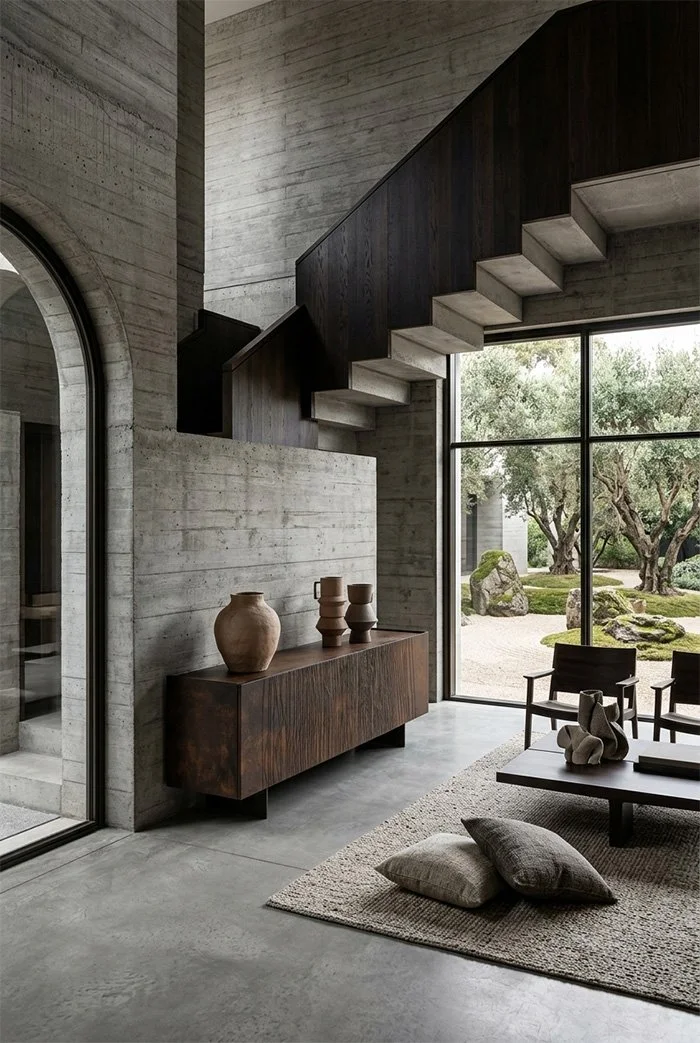
What Materials Define a Brutalist Living Room?
Material honesty is the foundation of every brutalist interior. Concrete, brick, steel, stone, and timber are presented in their natural state rather than concealed behind paint, veneer, or cladding - walls show the grain of the formwork that shaped them, and this honesty creates interiors with an authenticity and textural richness that manufactured finishes cannot replicate.
In a residential setting, this doesn't require a full architectural commitment. A single board-formed concrete wall, polished concrete floors, or even a micro-cement surface can anchor the room's material identity while the rest of the space remains warmer and more livable. The key is that whatever raw material you choose reads as genuine rather than applied.
What Furniture Works in a Brutalist Living Room?
Oversized furniture with sculptural forms works beautifully in a brutalist-inspired space - chunky, blocky sofas, geometric lighting, and abstract decor pieces all fit the aesthetic without making the space feel like a construction site. The furniture needs enough visual presence to stand beside raw concrete without feeling lightweight or decorative.
Dark walnut is particularly well-suited to brutalist interiors because it brings warmth and grain into a room dominated by grey tones, without softening the overall mood the way lighter timbers tend to. A low-profile walnut sofa with linen cushions, a walnut coffee table, and a dark walnut sideboard creates a consistent material language that works with concrete rather than contrasting it in a way that feels jarring.
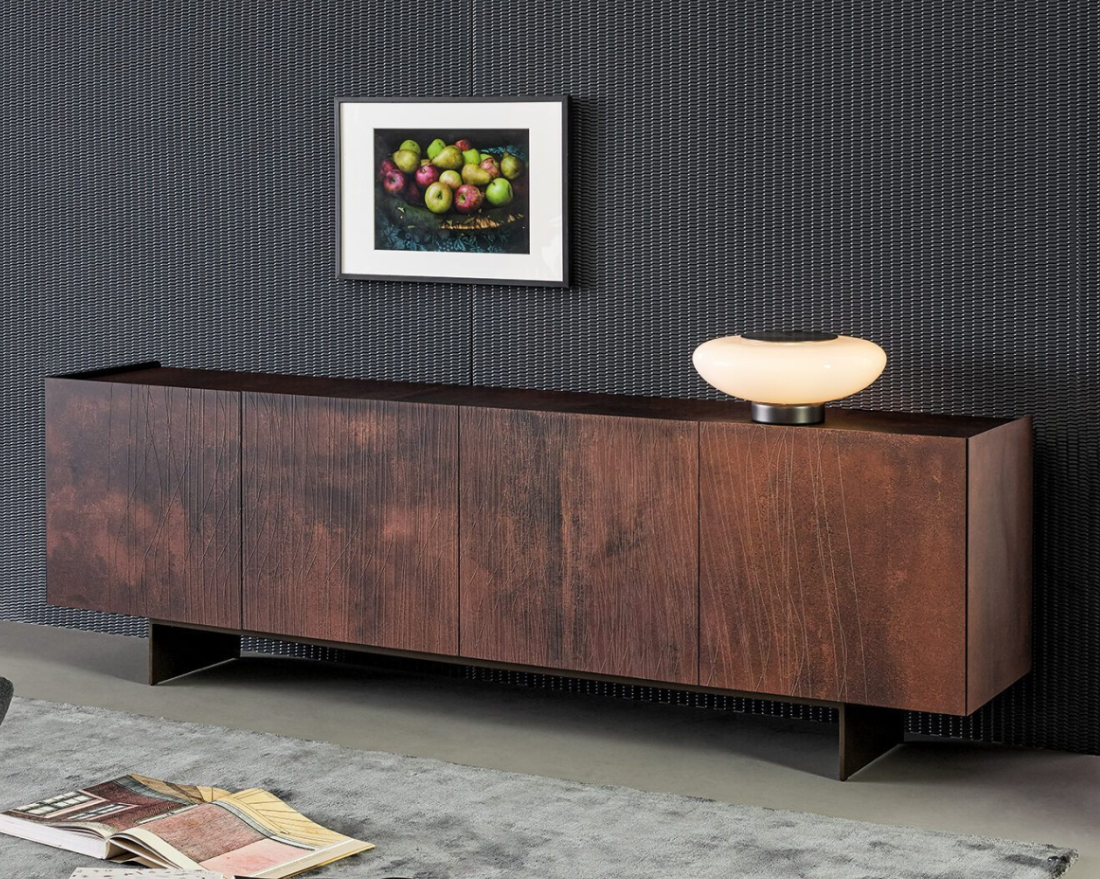
The Blush Sideboard by Bonaldo is a fitting example of furniture that earns its place in a brutalist room. Its front panels feature furrowed traces in slight relief that create a vibrating, iridescent surface - straight and curved lines following one another in a variable rhythm that mirrors and enhances the natural grain of the wood, creating a perceptive effect that shifts the sideboard's appearance from dark walnut to deep red depending on the light. It's designed with a double blade base that keeps the silhouette grounded and architectural. Made to order in Italy, with a 2-year guarantee, available through Transforma in Australia.
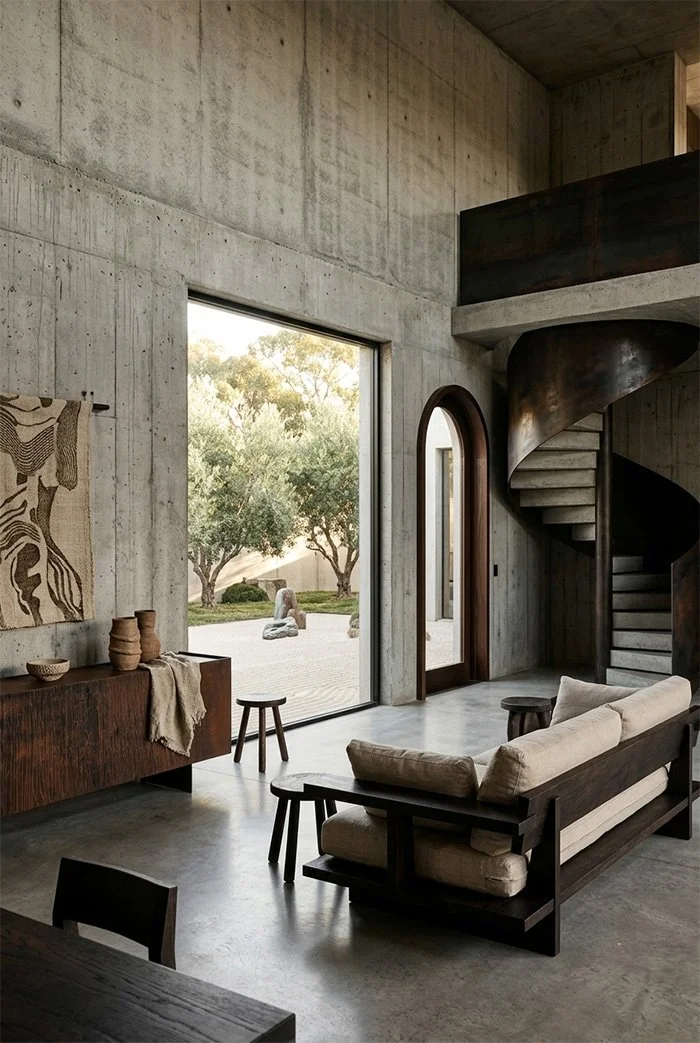
Brutalist Living Room
Dark, raw, relief, concrete
How Do You Add Warmth to a Brutalist Living Room Without Losing the Aesthetic?
The soft brutalism approach layers warm timber, rich textiles, and plants over raw concrete and steel surfaces, resulting in a space with extraordinary texture and visual drama that also feels inviting and livable - the key is balance, where raw materials provide the architectural backbone while natural materials and soft furnishings create comfort.
In practice, this means linen sofa cushions rather than leather, a jute or wool rug rather than nothing, and one or two terracotta or raw ceramic vessels rather than a collection of objects. Dried botanicals, textile wall hangings, and low-profile floor cushions all add warmth without introducing colour or decoration that competes with the architecture.
What Do You Put on the Walls in a Brutalist Living Room?
The wall itself is often the answer. In a room with board-formed or raw concrete walls, a large artwork needs to be considered carefully - it should either be substantial enough to hold its own against the texture of the wall, or minimal enough (a single framed line drawing, a textile hanging, or a large abstract canvas in muted tones) that it doesn't try to compete.
Brutalist rooms call for frames that maintain material honesty - matte black metal frames, raw oak, or natural wood float frames - while ornate or decorative frames clash with brutalist minimalism. A single large-scale artwork above the sideboard, hung so its bottom edge sits roughly 15–20cm above the surface, tends to anchor the wall without overcomplicating it.
How Many Objects Should You Put in a Brutalist Living Room?
Very few. Negative space is essential in brutalist rooms - they breathe, reject the impulse to fill every surface and corner with objects, and instead allow carefully chosen pieces to occupy space with presence and purpose, letting the architecture of the room itself command attention.
On a sideboard, this typically means two or three objects at most - a tall ceramic vessel, one smaller sculptural piece, and a linen throw draped with intention. On a coffee table, even less. The discipline of choosing one strong object over five smaller ones is what separates a brutalist room that reads as considered from one that simply looks unfinished.
Does a Brutalist Living Room Work in a Smaller Space?
Yes, with some adjustments. In tight spaces, focus on one standout feature - perhaps a concrete wall, a statement piece of furniture, or a striking light fixture - and use fewer elements with greater impact. A single board-formed concrete feature wall, a dark walnut sideboard with two ceramic vessels, and a low linen sofa is enough to establish the aesthetic in a smaller room without needing to commit to the full double-height, multi-surface treatment a larger brutalist space might have.
Enjoyed this design guide? Follow along on Pinterest for weekly editorial home inspiration.